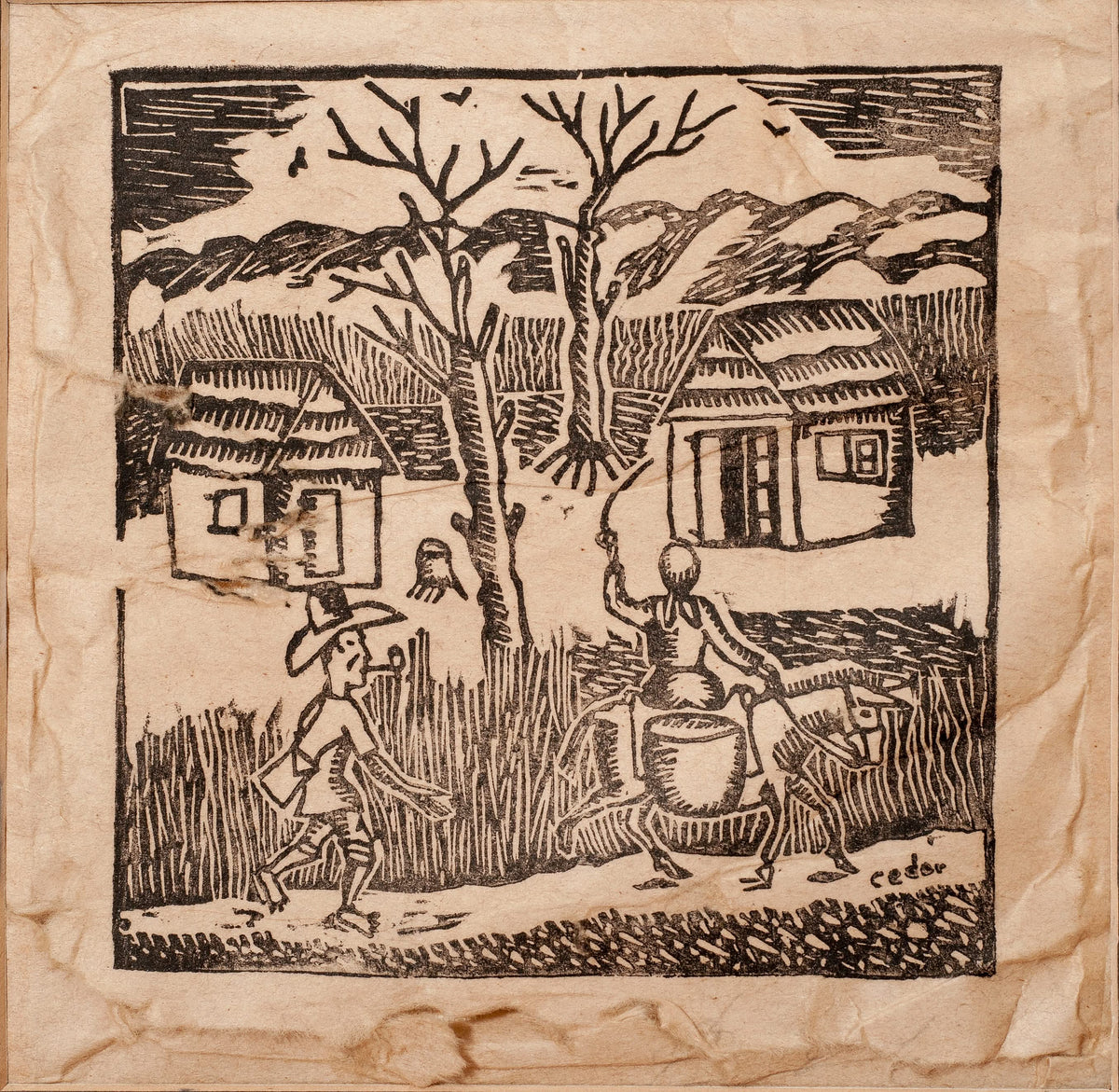
Dieudonné Cédor (Haitian, 1925–2010) 8" x 7" Village Road Scene, Circa 1969, Oil on Paper Drawing, Unframed, #1GSN, Family Collection of Marie & Georges S. Nader
Dieudonné Cédor (Haitian, 1925–2010) 8" x 7" Village Road Scene, Circa 1969, Oil on Paper Drawing, Unframed, #1GSN, Family Collection of Marie & Georges S. Nader
Regular price
$0.00
Regular price
$0.00
Sale price
$0.00
Unit price
per
Shipping calculated at checkout.
Couldn't load pickup availability
Certificate of Authenticity Included
Description
Description
A village road comes alive in this circa 1969 work by Dieudonné Cédor, rendered in bold black line against warm, creamy paper. A man in a wide-brimmed hat strides along the road with a pipe in his mouth, while a rider, seen from behind with one arm raised, sits astride a laden animal with a large round basket. Two peaked-roof houses and a pair of bare, branching trees stand against rolling hills, with tall grasses, drifting birds and dark bands of sky framing the scene. Dense hatching and crisp contours give the composition a strong graphic rhythm.
The work is signed lower right and comes from the family collection of Marie and Georges S. Nader. The thin paper shows creasing and a small area of loss at the left, consistent with its age. We will provide a Certificate of Authenticity.
About this artist
About this artist
Dieudonné Cédor (March 8, 1925–September 27, 2010) was a major Haitian painter born in L’Anse-à-Veau and recognized as one of the leading figures of modern Haitian art. He joined the Centre d’Art in December 1947, where he studied under the supervision of Rigaud Benoit, who introduced him to the foundational principles of pictorial art. Dewitt Peters, founder of the Centre d’Art, quickly recognized Cédor’s talent and leadership, appointing him chief of the studio. In 1949, Cédor was selected as a member of the Centre d’Art’s administrative committee. During a period of institutional conflict between artists and management, he was elected president of the Haitian Artists Association. He later became a founding member of the Foyer des Arts Plastiques (F.D.A.P.) and served as its director from 1952 to 1956, playing a crucial role in shaping Haiti’s postwar artistic infrastructure. In 1956, alongside Luckner Lazard and Roland Dorcély, Cédor co-founded Galerie Brochette, where he remained active until 1962. In 1957, he was appointed director of the Museum of Beaux-Arts of Port-au-Prince, further cementing his influence as both an artist and cultural leader. Cédor’s work spans a wide emotional and thematic range, addressing daily life, social realities, joy, sorrow, and the tensions of the human condition. As noted by Gérald Alexis in Peintres Haïtiens, “Cédor can handle any subject expressing joy or sorrow, the splendors, and anxieties of life.” His name appears in all major reference books on Haitian art, underscoring his lasting legacy