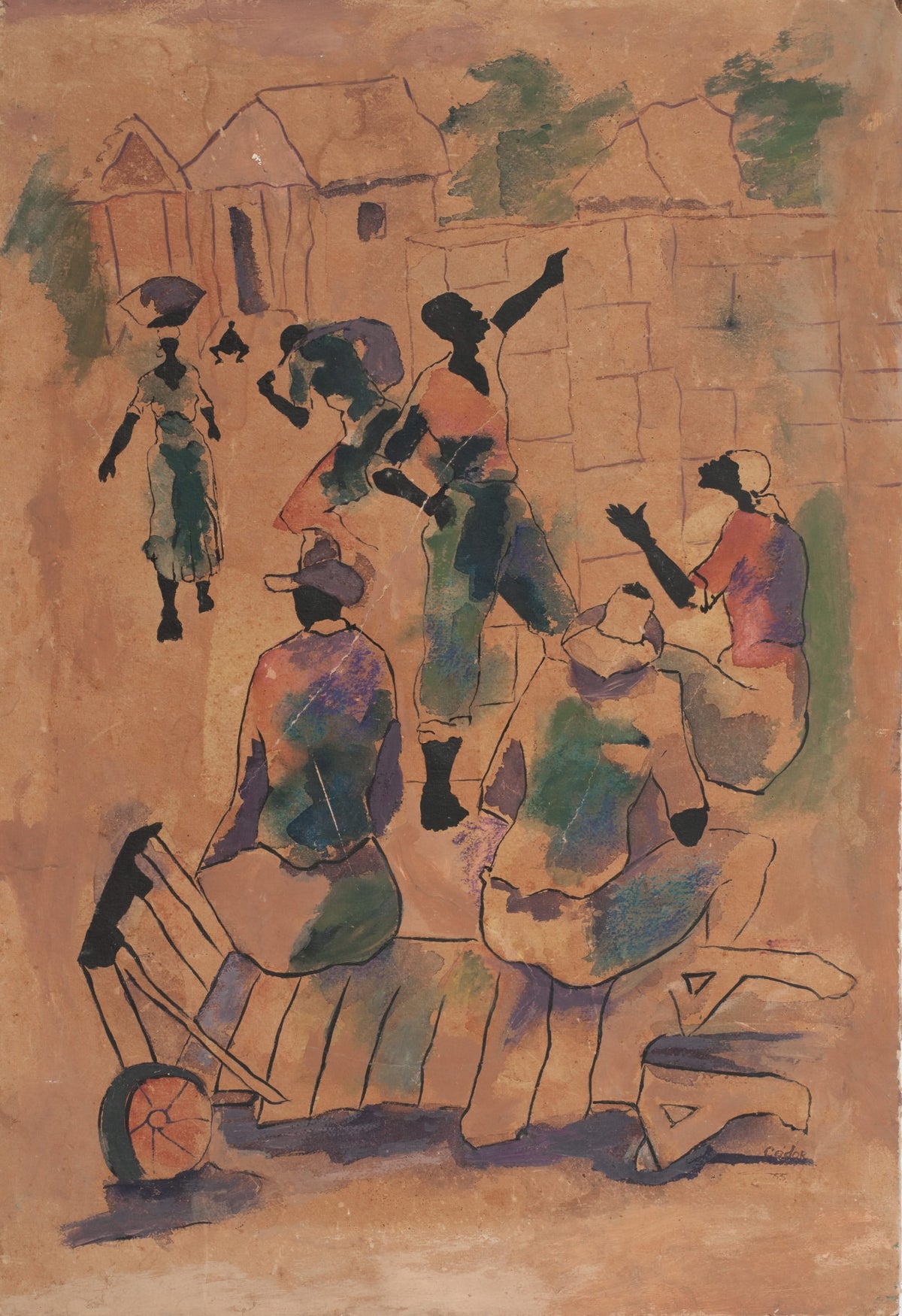
Dieudonné Cédor (Haitian, 1925–2010) 21.25" x 14.75" Village Scene with Wheelbarrow, 1965, Watercolor and Oil on Paper, Unframed, #210-3-96GSN, Family Collection of Marie & Georges S. Nader
Dieudonné Cédor (Haitian, 1925–2010) 21.25" x 14.75" Village Scene with Wheelbarrow, 1965, Watercolor and Oil on Paper, Unframed, #210-3-96GSN, Family Collection of Marie & Georges S. Nader
Regular price
$0.00
Regular price
$0.00
Sale price
$0.00
Unit price
per
Shipping calculated at checkout.
Couldn't load pickup availability
Certificate of Authenticity Included
Description
Description
Figures gather along a stone wall in this 1965 village scene by Dieudonné Cédor, set against a row of peaked-roof huts and drifts of green foliage. In the foreground, two seated figures turn their backs to us beside a wheelbarrow. Behind them, one figure stands with an arm flung upward, another gestures from the right, and a woman walks along the left with a bundle balanced on her head. Solid black silhouettes contrast with translucent washes of green, violet and coral across a warm, sandy ground, while fine contour lines give the scene a lively, rhythmic movement.
The work is signed and dated lower right and comes from the family collection of Marie and Georges S. Nader. Condition is good, consistent with its age. We will provide a Certificate of Authenticity.
About this artist
About this artist
Dieudonné Cédor (March 8, 1925–September 27, 2010) was a major Haitian painter born in L’Anse-à-Veau and recognized as one of the leading figures of modern Haitian art. He joined the Centre d’Art in December 1947, where he studied under the supervision of Rigaud Benoit, who introduced him to the foundational principles of pictorial art. Dewitt Peters, founder of the Centre d’Art, quickly recognized Cédor’s talent and leadership, appointing him chief of the studio. In 1949, Cédor was selected as a member of the Centre d’Art’s administrative committee. During a period of institutional conflict between artists and management, he was elected president of the Haitian Artists Association. He later became a founding member of the Foyer des Arts Plastiques (F.D.A.P.) and served as its director from 1952 to 1956, playing a crucial role in shaping Haiti’s postwar artistic infrastructure. In 1956, alongside Luckner Lazard and Roland Dorcély, Cédor co-founded Galerie Brochette, where he remained active until 1962. In 1957, he was appointed director of the Museum of Beaux-Arts of Port-au-Prince, further cementing his influence as both an artist and cultural leader. Cédor’s work spans a wide emotional and thematic range, addressing daily life, social realities, joy, sorrow, and the tensions of the human condition. As noted by Gérald Alexis in Peintres Haïtiens, “Cédor can handle any subject expressing joy or sorrow, the splendors, and anxieties of life.” His name appears in all major reference books on Haitian art, underscoring his lasting legacy