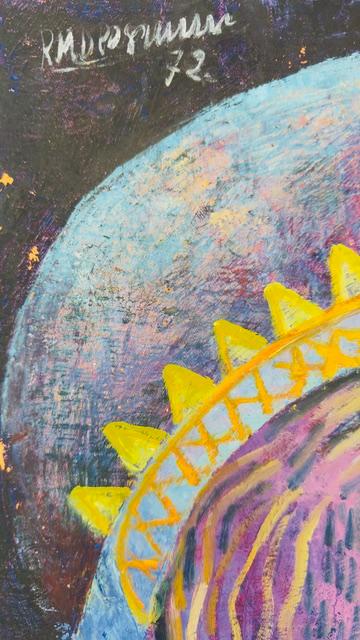
Collection: Rose-Marie Desruisseau (Haitian, 1933-1988)
Rose-Marie Desruisseau (August 30, 1953–1988) was a major Haitian woman painter born in Port-au-Prince who became known for her powerful use of color, cultural symbolism, and engagement with Haitian national identity. Raised in Diquini among working-class communities, Desruisseau developed an early sensitivity to everyday life, humor, and communication—qualities that shaped her lifelong commitment to art as both personal expression and cultural testimony. Determined to pursue painting despite social hesitation around women artists, she devoted herself at a young age to the study of color, form, and Haitian visual tradition. Desruisseau trained at Haiti’s Academy of Fine Arts under Amerigo Montagutelli and Géo Remponeau and later worked in the studio of Pétion Savain. She was deeply involved in Haiti’s artistic and cultural movements, participating from 1958 to 1961 in the Hall of Plastic Arts, Brochette, and Calfou. In 1960, she worked closely at Brochette alongside leading Haitian artists including Luckner Lazard, Dieudonné Cédor, Denis Émile, Néhémy Jean, Jean-Claude “Tiga” Garoute, and Antonio Joseph. During this period, she undertook intensive pictorial studies of Vodou, developing a mature artistic language grounded in ritual imagery, spiritual symbolism, and social consciousness. By 1963, her work had achieved significant force and originality. From 1967 to 1972, Desruisseau studied ethnography, strengthening the cultural depth of her art, and in 1977 she taught at the Academy of Fine Arts. Between 1960 and 1980, she exhibited widely throughout Haiti and internationally in Senegal, Caracas, Santo Domingo, the United States, Canada, and Martinique, and participated in multiple exhibitions at the French Institute of Haiti. In 1974, she received the Jacques Roumain First Prize for her celebrated painting Délivrance. Desruisseau’s paintings are recognized for their determination, patriotic spirit, and cultural involvement. As noted by Haitian art critic Gérald Alexis in Peintres Haïtiens, her work reflects “a highly talented woman’s determination to fight prejudice” while affirming her devotion to Haitian national culture. Desruisseau died in Montreal, Canada, in 1988, leaving a legacy as one of the most important Haitian female painters of her generation. Scroll down to make your selection (s)!