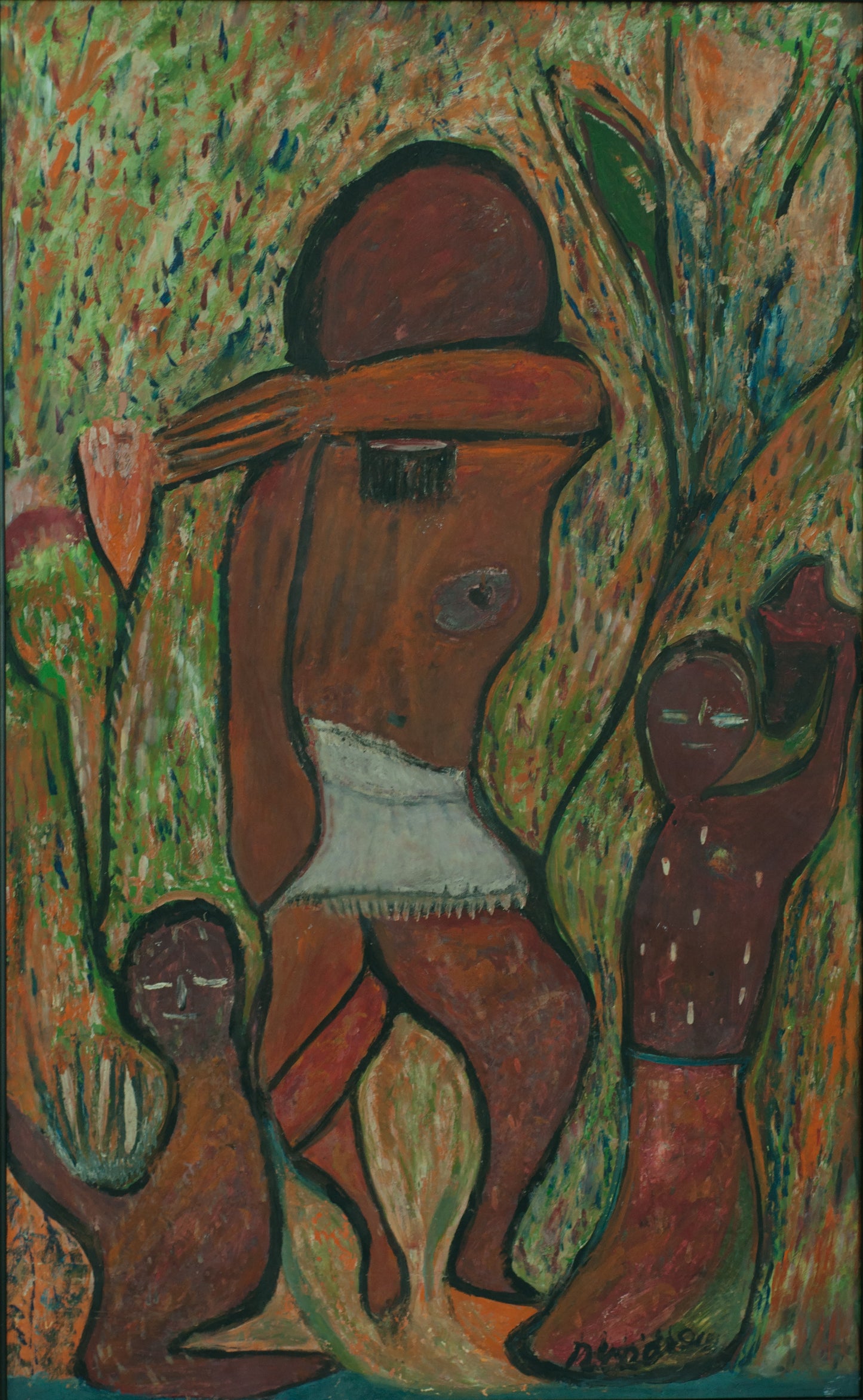
Robert Saint-Brice (Haitian, 1898-1973) 40"x25" Figure with Two Spirits 1971 Oil on Board Painting #6-3-96GSNHA-Private Collection of Marie & Georges S. Nader
Robert Saint-Brice (Haitian, 1898-1973) 40"x25" Figure with Two Spirits 1971 Oil on Board Painting #6-3-96GSNHA-Private Collection of Marie & Georges S. Nader
Regular price
$0.00
Regular price
Sale price
$0.00
Unit price
per
Shipping calculated at checkout.
Couldn't load pickup availability
Certificate of Authenticity Included
Description
Description
This expressive painting depicts a central standing figure set within a lush, textural landscape composed of layered greens, oranges, and earthy tones. The central figure, rendered with a rounded head and elongated limbs, wears a short white skirt and appears engaged in a ritualistic or spiritual gesture, with one arm extended across the chest. Two smaller, stylized figures flank the central form—one kneeling at the left and the other standing at the right—each distinguished by simplified facial features and warm, reddish-brown tones. The composition is framed by organic shapes resembling foliage or mystical forms, creating an atmosphere suggestive of Haitian spiritual symbolism and nature’s vital presence. Painted with thick, energetic strokes and vibrant color contrasts, the work reflects Robert Saint-Brice’s signature visionary style, merging the mystical and the earthly.
About this artist
About this artist
Robert Saint-Brice was born in Pétion-Ville, Haiti, on August 29, 1898, and died on August 20, 1973. Unable to read or write, and long before he became an artist, Saint-Brice worked in many modest jobs—including shopkeeper, cook, peddler, and court messenger—to make ends meet. His artistic career started unexpectedly in his fifties when he met the American artist Alex H. John. Impressed by Saint-Brice’s early paintings, Jones showed them to DeWitt Peters in 1949, opening the doors of the Centre d’Art to him. Saint-Brice’s rise happened quickly. In 1955, the Flagg Tanning Corporation Collection purchased three of his paintings, and by 1960, he had his first solo show in New York. Haitian intellectuals of that era admired him as one of the country’s top “primitives”—a leading figure in Haiti’s early modern art movement. Saint-Brice, a practicing Vodou priest, created semi-abstract but clearly figurative works inspired by spiritual visions. He often said that his ideas came to him in dreams as messages from ancestral spirits. The number three appears repeatedly in his compositions, a symbolic structure he referred to mysteriously when explaining his creative process. His paintings challenged expectations. As Gérald Alexis notes in Peintres Haïtiens, “Saint-Brice’s paintings disturbed art critics in the early 1950s, who were accustomed to the descriptive realism of Haitian folk painters.” His bold, visionary imagery offered something radically different—an interior, mystical expression deeply rooted in Vodou cosmology. Today, Saint-Brice is recognized as one of the leading spiritual painters of Haiti’s mid-20th-century art movement. His distinctive style continues to enchant collectors and scholars worldwide.